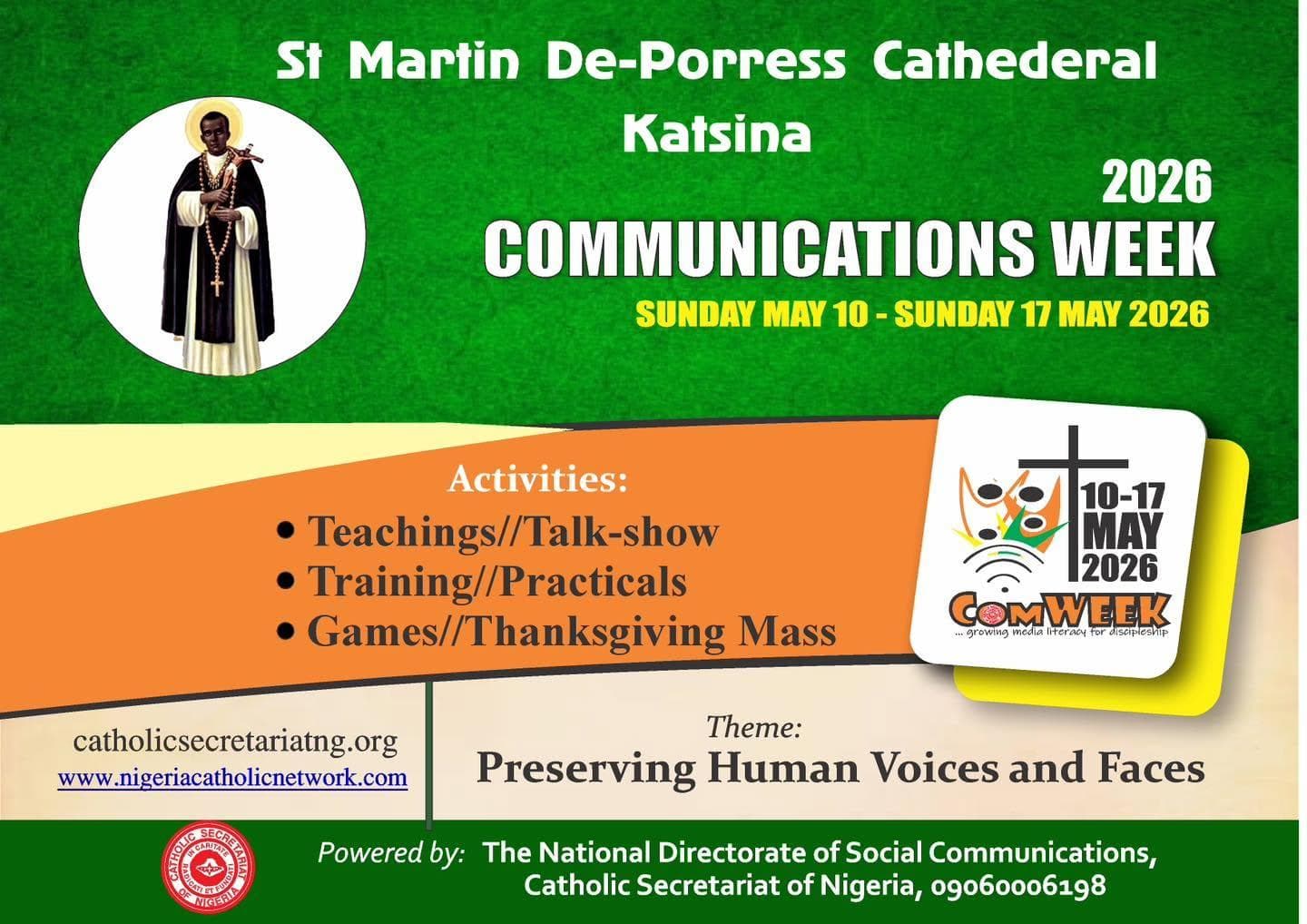
The second day of Communication Week at St. Martins De Porres Catholic Cathedral, Katsina, featured a Rosary procession, Holy Mass, and an enlightening formation session on the importance of the human voice and identity in the age of Artificial Intelligence (AI).
The day's activities commenced at 5:30 p.m. with a Rosary procession led by Mrs. Josephine Amodu. The procession was followed by the celebration of Holy Mass at 6:10 p.m., presided over by Rev. Fr. Damian Zomahoun.
Holy Mass and Reflection on the Word of God
The Liturgy of the Word featured readings from Acts 16:11–15, Psalm 149, with the response, “The Lord takes delight in His people,” and the Gospel according to John 15:26–16:4, proclaimed by Rev. Fr. Damian Zomahoun.
The faithful participated actively in the Offertory and Liturgy of the Eucharist. The Holy Mass concluded with the final blessing at 6:45 p.m.
“My Voice Is My Identity”
Immediately after the Mass, at 6:47 p.m., participants gathered inside the church for a formation session titled “My Voice Is My Identity.”
The session was introduced by Sir Stephen Aluko, who emphasized the essential role of human communication in the proclamation of the Gospel and the building of society.
He also drew attention to the growing influence of Artificial Intelligence, noting that while AI has the potential to serve humanity positively, it can equally be misused to deceive, manipulate, and cause harm.
Reflecting on John 10:27, “My sheep listen to my voice; I know them, and they follow me,” Sir Aluko explained that the human voice is more than a means of producing sound. It carries elements of an individual's emotions, upbringing, culture, values, and intentions.
He noted that the uniqueness of the human voice enables children to recognize their parents, friends to identify one another over the telephone, and leaders to inspire people through speech.
Technology, AI and the Threat to Human Identity
The session examined the ways modern technology and Artificial Intelligence can imitate human voices and faces, creating new challenges for personal identity, trust, and responsible communication.
Among the challenges highlighted were:
AI tools capable of imitating human voices and faces.
Deepfake videos and manipulated digital content.
Fake online identities.
Voice scams targeting families and businesses.
False information disseminated through manipulated videos and speeches, potentially causing panic, hatred, and mistrust.
Misuse of social media through cyberbullying, gossip, online fraud, tribal hatred, and character defamation.
Participants were reminded that the advancement of technology must not come at the expense of human dignity, truth, and trust.
The Voice as an Expression of Identity
The presentation highlighted two important dimensions through which the human voice expresses identity.
Cultural Expression:
Greetings, songs, stories, and local languages serve as important means of preserving cultural heritage, history, and identity.
Personal Identity:
The manner in which people use their voices can reveal their values and character, whether through truth or falsehood, kindness or hatred.
The speaker therefore encouraged participants to recognize the responsibility that comes with the ability to communicate.
Responsibilities of a Christian Communicator
The session identified several responsibilities expected of anyone involved in communication, particularly in the digital age. These include:
Verifying information before sharing it.
Speaking truthfully.
Respecting human dignity.
Protecting privacy.
Promoting peace and unity.
Avoiding manipulation and deception.
It was emphasized that technology should assist humanity rather than destroy trust.
Participants were reminded that human voices carry personal identity and should therefore be used to build individuals, families, communities, and society rather than destroy them.
Protecting Human Authenticity
The presentation also highlighted practical ways individuals can protect their voices and identities in the digital age. These include preserving human authenticity, practising positive communication, protecting one's digital identity, and educating others about the dangers of digital manipulation.
Several biblical passages were cited to reinforce the Christian responsibility to use speech wisely, including Ephesians 4:29, Psalm 19:14, Proverbs 18:21, James 3:5–6, Matthew 12:36, Colossians 4:6, and Exodus 20:16.
These passages collectively encourage believers to use their words constructively, speak with grace and truth, and avoid speech that causes harm to others.
Parishioners Seek Guidance on AI and Digital Identity
The session generated questions from parishioners, particularly concerning how individuals can protect their identity and personal information in an era of rapidly advancing Artificial Intelligence.
The questions were addressed by the host alongside Very Rev. Fr. Luka Yohanna Magaji, who provided further clarification and guidance to the participants.
The session emphasized that as technology continues to evolve, individuals must become increasingly conscious of protecting their identity, integrity, privacy, and authenticity.
The day's activities concluded at 8:15 p.m. with the closing prayer and final blessing given by the Diocesan Chancellor, Very Rev. Fr. Luka Magaji Yohanna.
Day Two of Communication Week therefore provided the faithful with both spiritual and practical formation, challenging them to become responsible communicators who use their voices and modern communication technologies to promote truth, human dignity, peace, and unity.
✍️ Judith Onwordi